A Quiet Place for Prayer
AI generated
Not everyone has a room reserved solely for prayer. More often, we pray in a space where, only a few hours earlier, someone may have been working, eating or attending to the ordinary business of the day. There is nothing lacking in this. Prayer requires neither a room furnished for that purpose nor a threshold beyond which everyday life must be left behind. The Prophet ﷺ taught that the earth had been made a place of prayer (Sahih al-Bukhari 335). A clean and quiet space may therefore be entirely sufficient.
And yet, there is comfort in having a place to which one regularly returns.
Not because such a place lends greater worth to the prayer, but because it makes the practicalities of daily life easier. The minutes between the Adhān and the first takbīr can gather a surprising number of small obstacles. Where is the prayer mat? Is the prayer garment ready? Is the floor clean? Does anything need to be moved first? None of these questions is significant in itself. Together, however, they can be enough to turn praying now into intending to pray shortly.
A well-considered prayer space removes these decisions. It is prepared without appearing contrived. It keeps what is needed close at hand and allows everything to have its proper place. Above all, it shortens the distance between the arrival of the prayer time and the prayer itself.
Choosing the Right Place
A prayer space need not be generous in size. It requires only enough room for every movement of the prayer to be performed freely. The most reliable way to judge this is to lay out the mat and move carefully through standing, bowing and sujūd. There should be no risk of touching nearby furniture or having one’s clothing restrict the movement. The amount of space required cannot be reduced to a single measurement. Height, clothing and freedom of movement matter far more than any prescribed dimensions. A quiet area away from a frequently used passage is usually best. Any clean, open space may be suitable, provided that it offers sufficient room and is unlikely to be disturbed for the duration of the prayer. A thoroughfare that is regularly used is less appropriate. Even when it appears empty at a particular hour, it remains part of the movement of daily life.
The surface must not merely appear orderly. It must also be free from ritual impurity. A bathroom or toilet area should ordinarily be avoided as a place of prayer. Areas in which there may be contamination, unpleasant odours or uncertainty about cleanliness are likewise best avoided. Mere proximity to such an area does not make an otherwise clean surface impure, but a prayer space should allow both calm and confidence in its cleanliness. Where the floor is carpeted, it is sensible to maintain it carefully and deal with any contamination without delay. The condition of the prayer space should not first need to be established after the prayer time has already begun.
What lies ahead of the place is equally important. The eyes do not cease to perceive their surroundings during prayer. A crowded shelf, a conspicuous picture or a restless pattern can draw the attention even when one is scarcely aware of it. A clear wall, or one arranged with restraint, is far more conducive to concentration.
Establishing the Qibla Reliably
From Britain, the Qibla lies broadly east-south-east. This is only a general indication, however. The precise bearing varies according to location and should therefore be established for one’s own address.
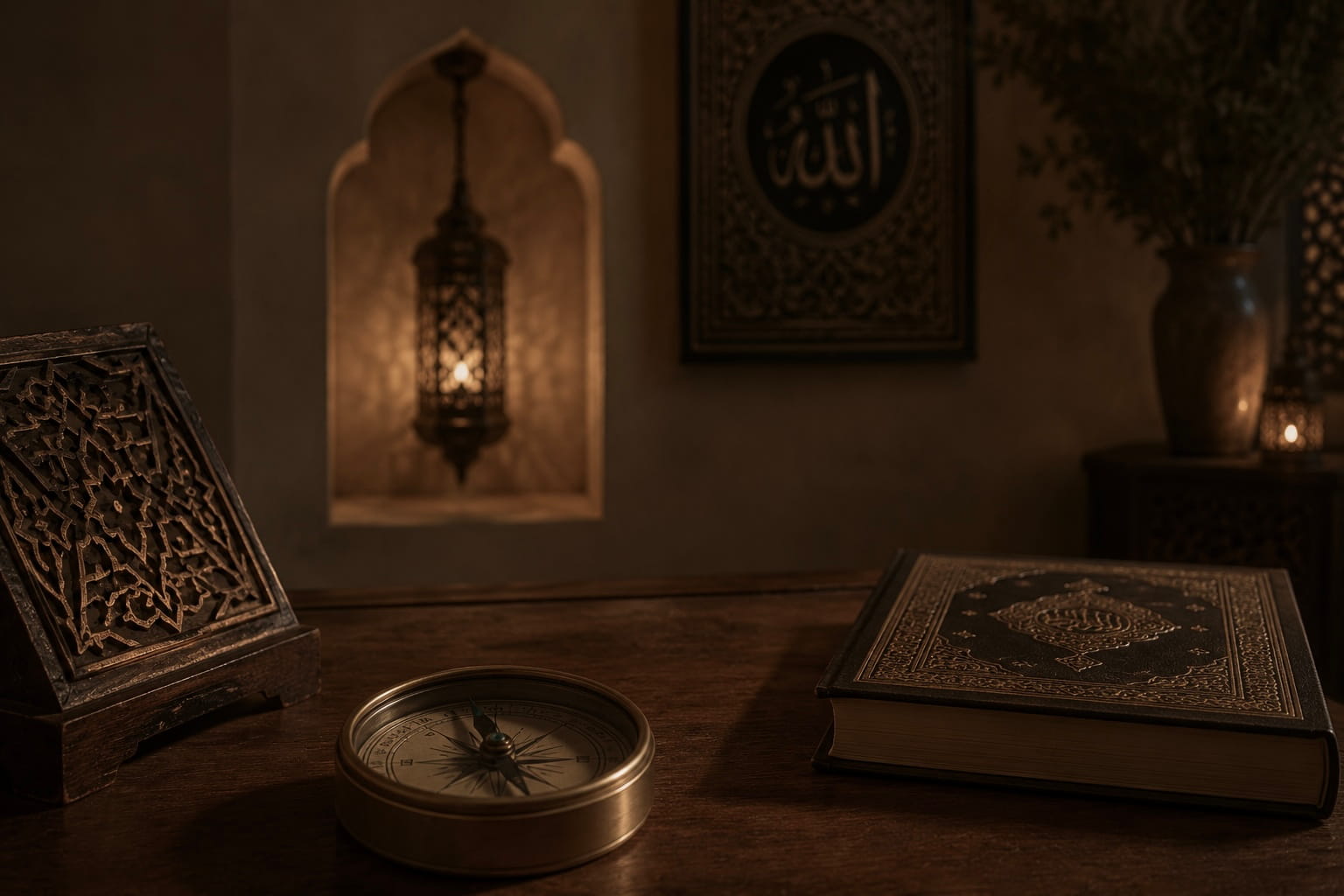
A dependable map-based Qibla finder is usually the simplest way to do this. If there is any uncertainty, a trusted local mosque may also be able to confirm the direction. A compass can be useful once the correct bearing is known.
Indoors, however, compass readings may be affected by metal and electronic devices. Metal surfaces, speakers, mobile phones and larger electrical appliances can all interfere with the result. It is therefore wise to check the direction at some distance from such objects, calibrate the device where necessary and verify the reading more than once.
Once the direction has been established, a discreet marker is sufficient. It might be the edge of a rug, the line of a floorboard or a small mark near the skirting board. It should be something that remains recognisable at Fajr without requiring the whole room to be brightly lit.
AI generated
A Beautiful and Considered Space
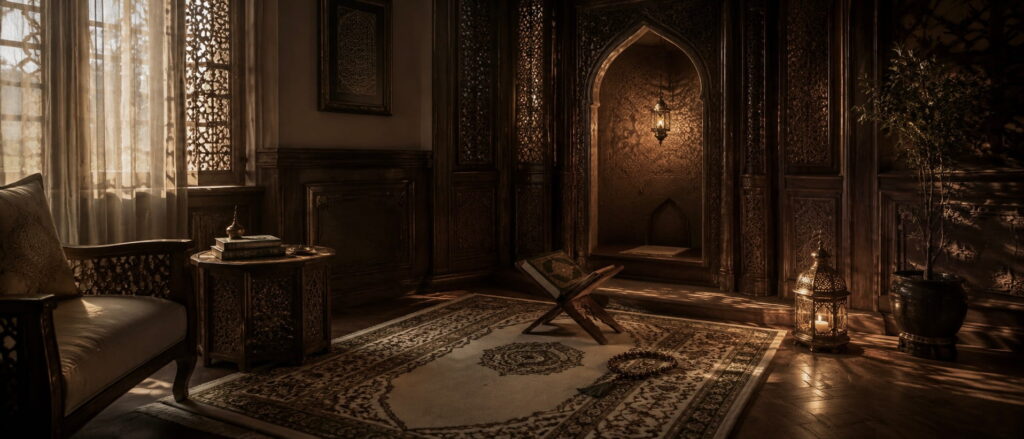
A prayer space may be beautiful and personal. Brass lanterns, dried flowers, calligraphic prints or carefully chosen books can bring warmth and dignity to it. The arrangement should allow the space to remain calm, ordered and ready for prayer. Prayer should be able to begin without unnecessary preparation. Decorative elements can have their place, provided that nothing must first be removed, rearranged or carefully put back in order. Beauty and practical calm need not stand in opposition to one another.
A lamp provides gentle light at Fajr. A basket keeps the prayer garment clean and within reach. A beautiful object may lend the space a personal character. Not everything must justify its presence through usefulness. It is enough that the space remains composed and that nothing draws attention away from the prayer.
Keeping the Essentials Together
When a prayer is delayed, the reason is not always a lack of resolve. Sometimes the prayer clothing is in the wash, the spare garment is not within easy reach or the prayer mat has been put elsewhere after cleaning. These are practical difficulties and may be answered with equally practical solutions.
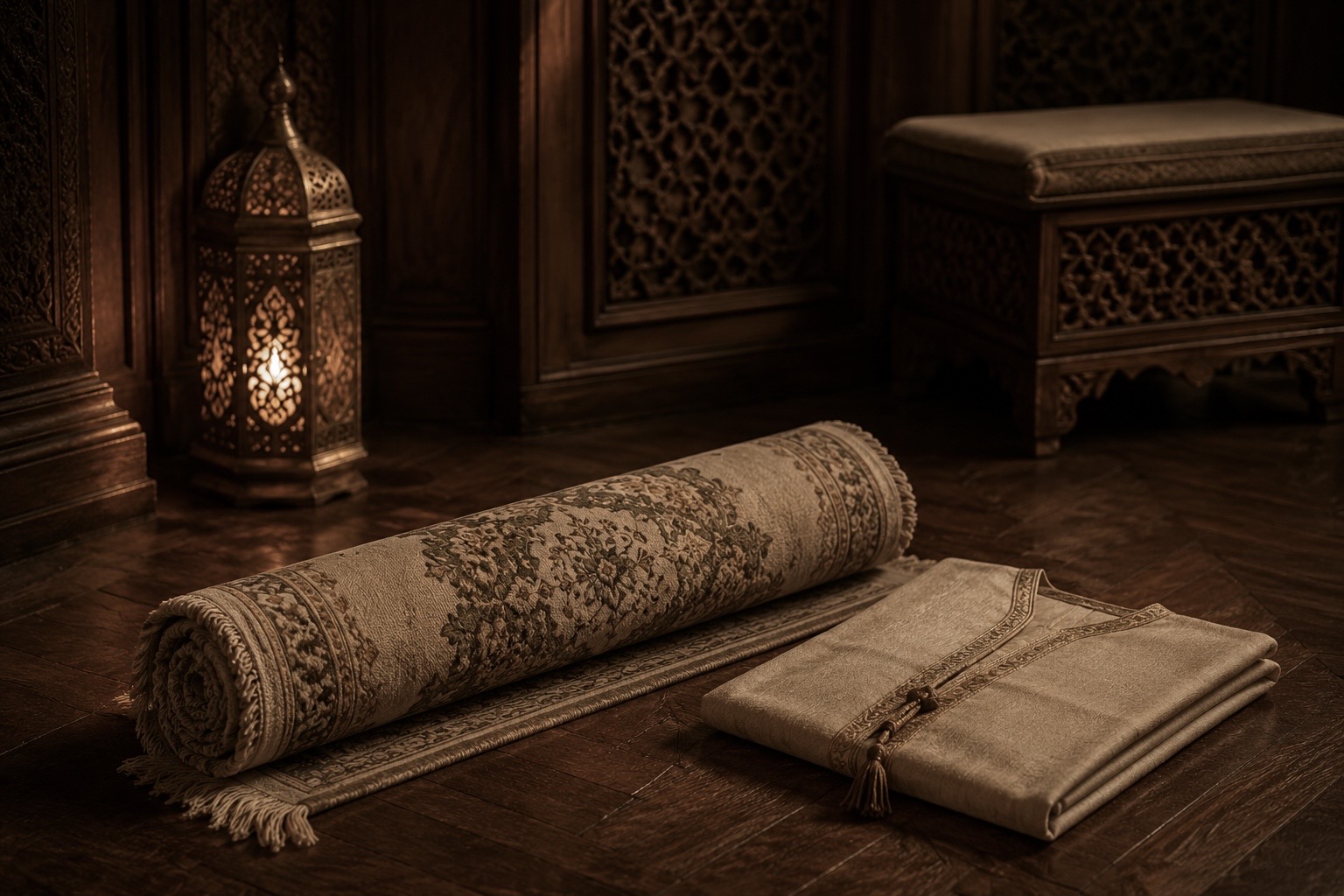
A lidded basket or a small chest beside the prayer space can hold a folded prayer garment and other smaller items that are used regularly. The lid protects the contents from dust and helps ensure that everything remains clean and ready when required.
When choosing a prayer mat, a quiet colour or a finely woven geometric design can sit easily within its surroundings and help keep visual distraction to a minimum. Comfort and stability deserve equal attention. Very deep, soft pile can shift beneath the hands and knees, while a denser surface with sufficient cushioning and a backing suited to the floor will usually remain more secure. Those who need additional support for the knees may prefer a little more padding. Care is worth considering as well. A mat that can be cleaned without difficulty is easier to keep fresh and ready for regular use.
Prayer clothing should be opaque, generously cut and designed to remain in place throughout the prayer. It should not slip when rising or require constant adjustment in sujūd. Cotton and soft viscose may feel more comfortable in warm weather than firmer polyester fabrics, although the density and quality of the weave matter as much as the fibre itself.
All these things exist solely to make prayer easier. A special mat and a garment purchased exclusively for prayer are not conditions of its validity. What matters is a ritually clean surface and clothing that fulfils the necessary requirements. These objects are intended to bring order to daily practice, not to serve as displays of devotion.
A Worthy Place for the Qurʾān
The Muṣḥaf should be kept in a clean and dignified place, where no everyday objects are laid upon it. A firm surface, or a place set aside especially for it, is preferable to a pile beside the prayer mat. At the same time, the Qurʾān should remain within easy reach without being left carelessly at floor level among other things.
A wooden rehal serves a practical purpose. It raises the Muṣḥaf, holds it open at a comfortable reading angle and can reduce strain on the binding. Once the reading is finished, it can be folded and stored compactly. Stability, a smooth finish and a size suited to the Qurʾān edition actually being used are important considerations.
Those who wish to deepen their understanding alongside recitation may also keep a Qurʾān edition with a translation nearby. The reliability of the translation and the quality of its commentary are worth careful consideration.
Five minutes of reading immediately after prayer will often prove more valuable than the intention to return later in the evening. What is already within reach is more readily allowed to become a habit.
AI generated
Gentle Light for Fajr and ʿIshā
Fajr arrives while the world is still dark and quiet. ʿIshā, too, is often prayed after the surroundings have grown still. At such hours, a bright overhead light can feel unnecessarily severe and may disturb others nearby.
A small table lamp or wall light with a warm bulb is usually sufficient. A colour temperature of around 2700 kelvin gives a calm, gentle light and is less stark than a cool white bulb. The lamp should stand or be fixed to one side, allowing the light to fall across the prayer space without shining directly into the eyes when standing.
The cable deserves particular care. It should never cross the prayer mat or any area through which the body moves during prayer. A touch-operated lamp, or one with a switch that can be found easily in the dark, is especially practical. In the stillness before sunrise, so small a convenience can make the transition into prayer noticeably gentler.
The Time After the Salām
The prayer ends with the salām, yet the minutes that follow possess a value of their own. They are easily lost in the movement of the day. No sooner has the prayer ended than the mind begins to turn towards the next task, the next message or the next responsibility.
Dhikr after the prayer creates a quiet interval. What might otherwise be a moment of merely remaining seated becomes a deliberate act of stillness. No object is required for this. It is reported that the Prophet ﷺ counted the tasbīḥ on his fingers. This remains the simplest method and is available at all times.
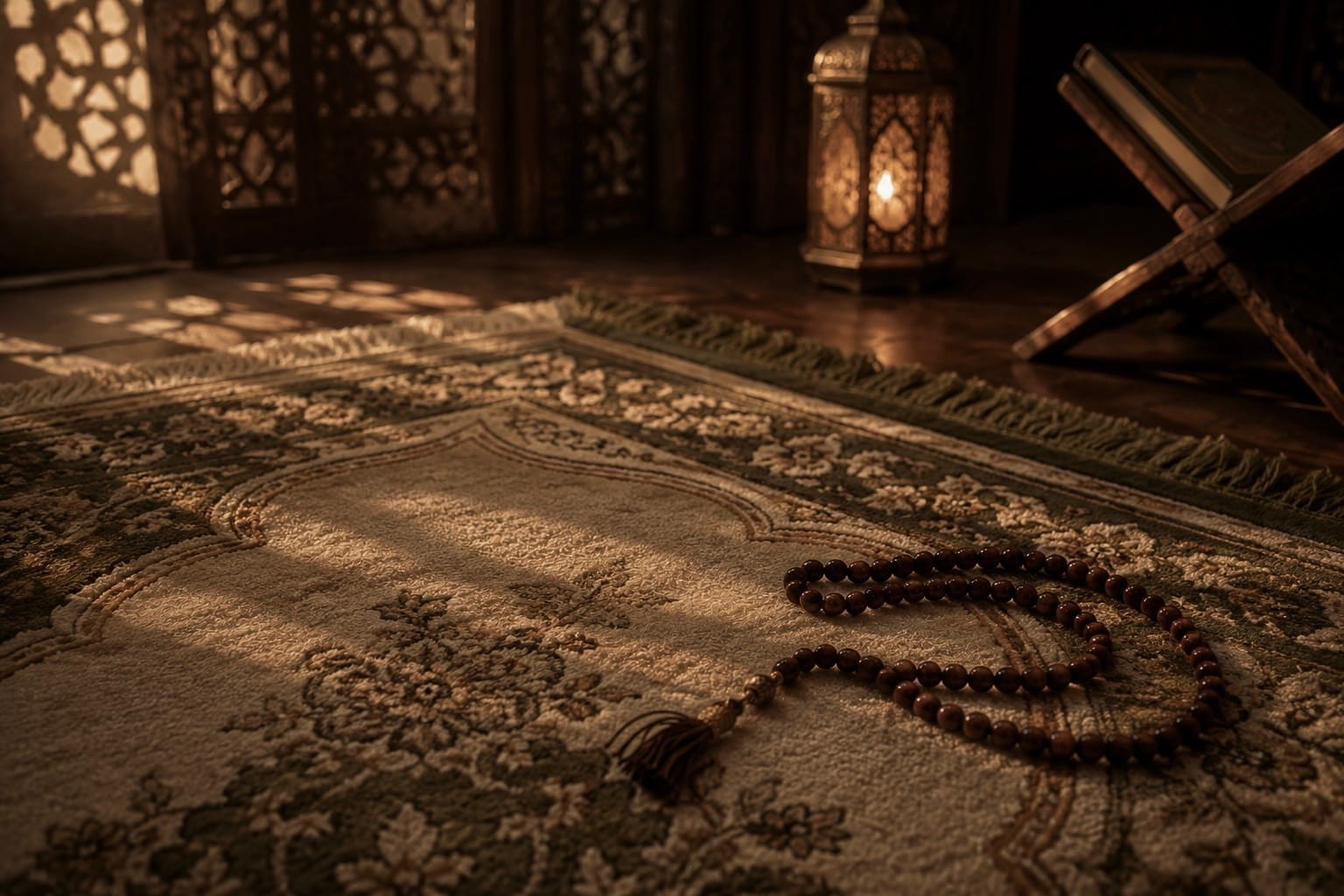
Some people nevertheless find that prayer beads or a small digital counter help them remain seated a little longer. If so, one may be kept within reach. Its value lies only in serving as a reminder of the dhikr.
AI generated
How a Place Becomes a Habit
None of the objects described here determines whether a prayer is valid. Prayer may be offered upon a clean, uncovered floor. A prayer mat, a rehal, a lamp or a basket is simply an aid to daily life. None is a measure of devotion or a visible proof of piety.
The influence of a fixed prayer space is far quieter. It answers the practical questions before they arise. The direction is known. The surface is clean. The garment is ready. The mat does not need to be found, and nothing must first be moved aside. When the prayer time begins, only the step towards prayer remains.
With time, the place acquires a significance that cannot be arranged or purchased. What was once an ordinary part of a room gradually becomes the place in which countless prayers have been offered.
That is the true beauty of a prayer space: it becomes familiar, and one returns to it again and again.