Paris in the Glow of Another Age: The Opéra Garnier
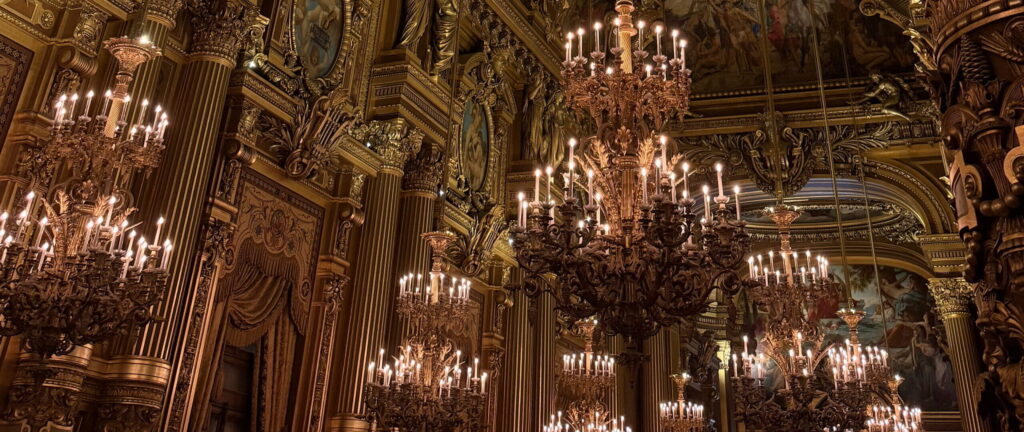
grand foyer, opéra garnier, paris © elegance & heritage
The Opéra Garnier has the peculiar familiarity of a Paris landmark you seem to know before ever standing in front of it. At the end of the Avenue de l’Opéra, its façade rises above the constant movement of the city with such composure that the surrounding space can feel as though it had been arranged for the building alone.
Yet the exterior gives remarkably little away. I expected splendour when I first visited: marble, gold, and the monumental scale for which the Palais Garnier is famous. What I had not expected was how much more powerful the interior would feel in person. Its richness is part of the impression, certainly, but so is the way the rooms reveal themselves in space and movement, something even the most familiar photographs never quite manage to convey.
Before the First Visit
Before visiting a historic place for the first time, I usually read a little about its past. I have no desire to arrive already knowing every detail. I simply want enough context to understand what I am looking at, and why a building has taken the form in which it survives today.
Far from diminishing the surprise of seeing a place for the first time, that small amount of knowledge sharpens it. A name carved into a room, a recurring symbol or an unusual decorative choice stops being merely ornamental once its significance is understood. Before entering the Opéra Garnier, I already knew something of Charles Garnier, the great staircase, the Grand Foyer and Marc Chagall’s painted ceiling. Only inside the building did those separate facts begin to belong to one another.
A Palace Built for Art and Society
The decision to build a new opera house was made under Napoleon III. When a competition was announced in 1860, the thirty-five-year-old Charles Garnier won against 170 other submitted designs. Construction continued for fifteen years, and the Palais opened on 5 January 1875. A building conceived under the Second Empire was thus brought to completion by the Republic.
To understand the Palais Garnier, it helps to forget the idea of an opera house as simply an auditorium reached by a series of practical entrances and corridors. Garnier conceived something much more elaborate: staircases, galleries and salons arranged so that the evening began long before anyone took a seat.
The approach to the performance became a performance of its own. Visitors were meant to arrive, ascend, pause and meet. The architecture allowed people to watch one another as readily as they admired the building around them. That element of social theatre has never entirely disappeared. Even in daylight, with no performance about to begin, the rooms still seem to expect an audience.
The Grand Staircase
The transformation begins at the Bassin de la Pythie. Beyond the bronze figure of Pythia, the hall of the grand staircase rises to almost thirty metres. Broad marble steps climb, divide and continue beneath open galleries in different directions. From the balconies, the arriving crowds can be seen below, while coloured marble, mosaics, gilding and painted ceilings draw the architecture steadily upwards.
Here, more than anywhere else, I understood the limitations of photography. A photograph usually fixes the staircase from a single point. Walking through it is entirely different. The proportions shift with every few steps: from below it feels monumental; from the upper galleries, almost theatrical. You are no longer simply looking at the architecture. For a moment, the architecture has placed you within its scene.
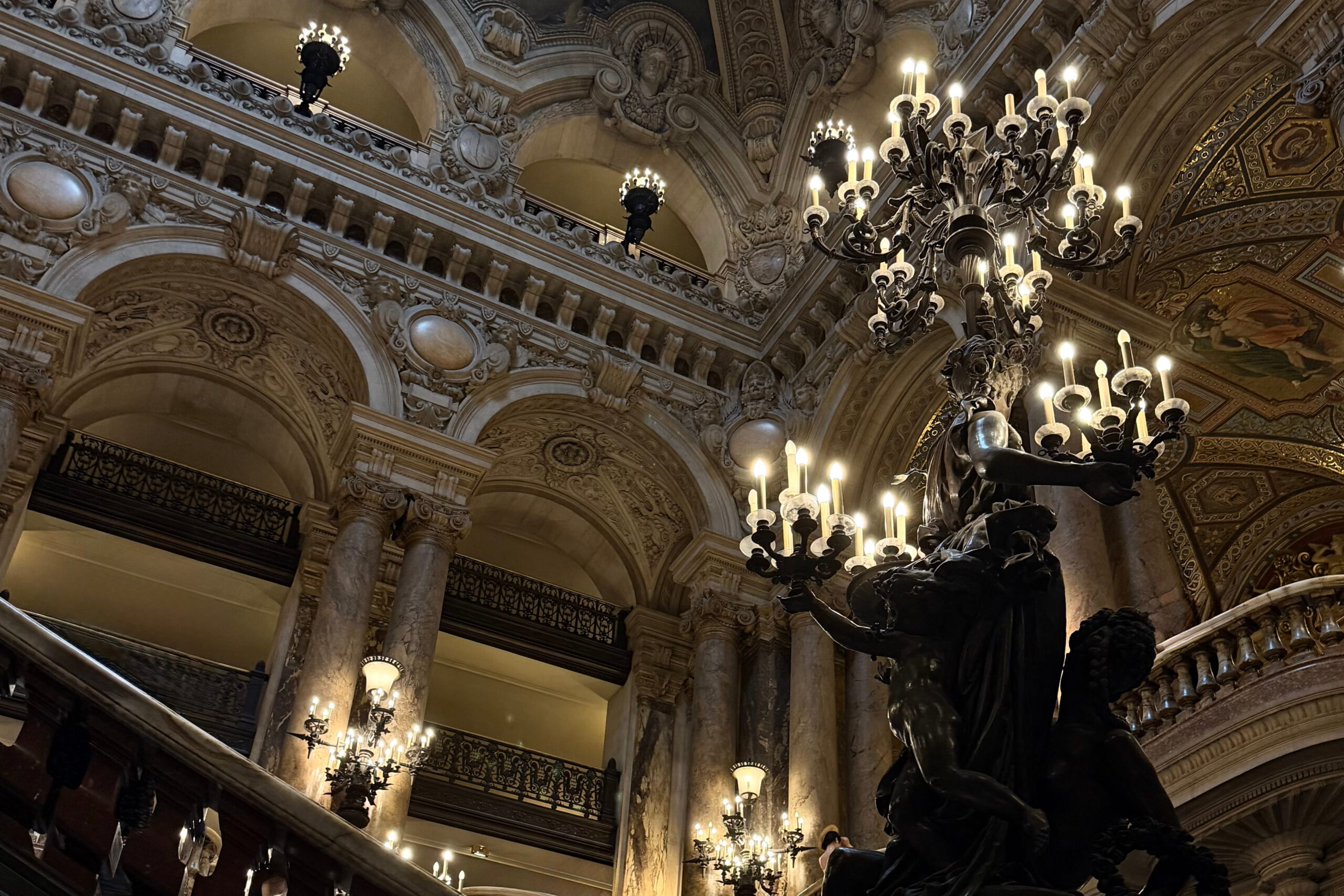
grand escalier, opéra garnier, paris © elegance & heritage
That is why the staircase was never merely a means of reaching another floor. It gave ceremony to arrival. At a time when attending the opera was as much a social occasion as an artistic one, entering the building was already a public event.
The Grand Foyer and Its Salons
Beyond the staircase lies the Avant-Foyer, with mosaics gleaming against golden backgrounds. Then comes the Grand Foyer, the most opulent room in the Palais. High windows and mirrors lengthen the gallery, while Paul Baudry’s paintings carry the eye towards the ceiling. Everywhere, the lyre reappears as an emblem of music: on capitals, heating grilles and even door handles.
What held my attention was not simply the abundance of decoration, but the care with which it had been brought under control. Vast paintings, mirrors and gilding belong to the same visual language as the smallest metal fittings. Nothing seems to have been treated as incidental.
The Grand Foyer was designed for walking, conversation and encounters during the intervals. Its magnificence therefore had a purpose beyond display. It provided the setting for a social ritual. The opera unfolded not only on the stage; the audience, too, formed part of its spectacle.
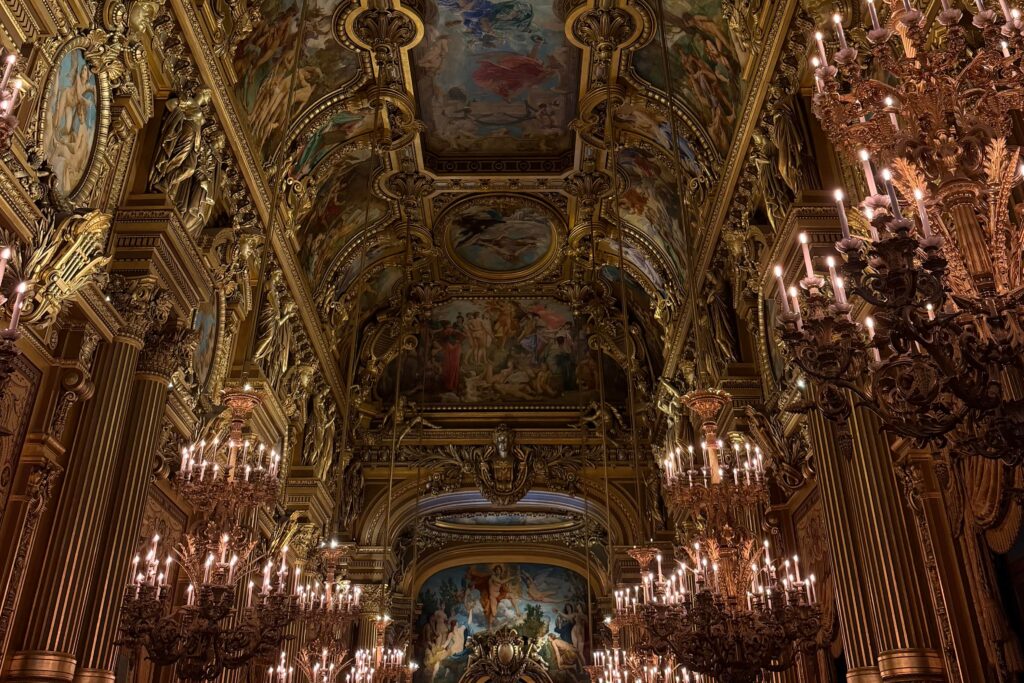
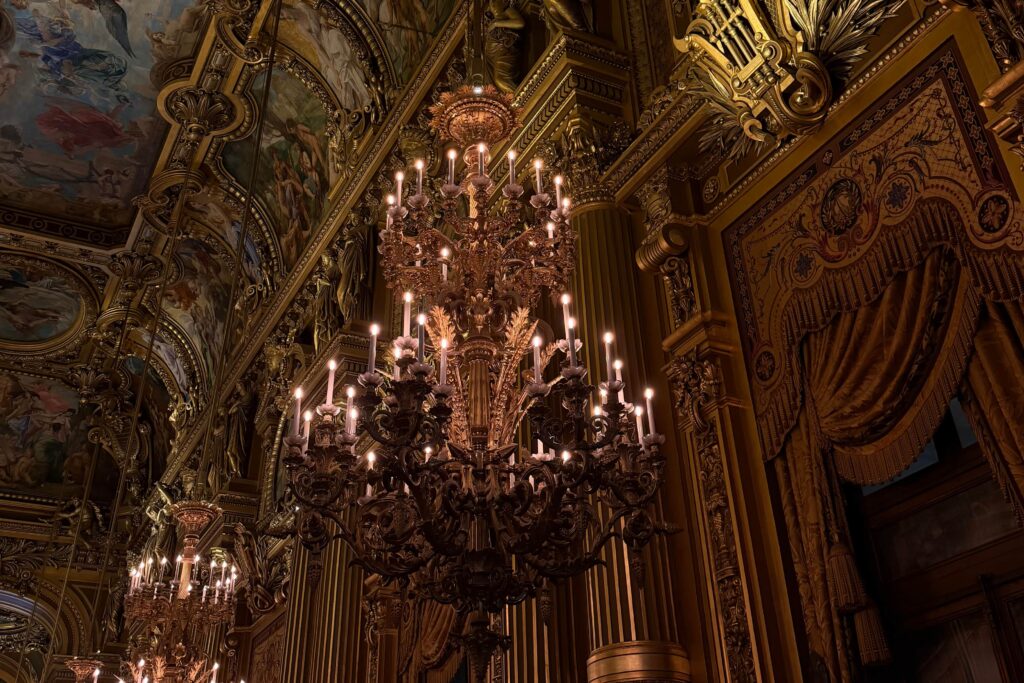
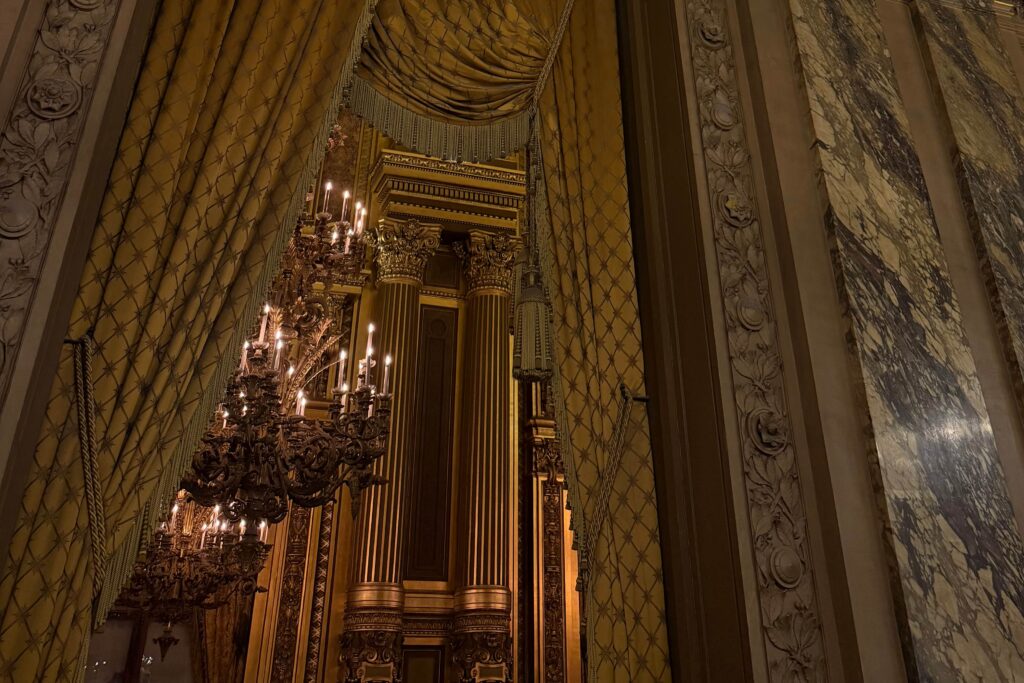
grand foyer, opéra garnier, paris © elegance & heritage
Beside so large a gallery, the Salon du Soleil and Salon de la Lune feel almost like jewel boxes. One is dressed in black and gold, the other in black and silver. A dragon and salamander ornament the first; owls and bats appear in the second. The brighter Salon du Glacier already belongs to the lighter mood of the Belle Époque. During intervals, refreshments and delicate pastries were once served there.
These smaller rooms deserve to be looked at slowly. Details that might disappear amid the scale of the staircase or the brilliance of the Grand Foyer become more visible here, and with them comes a clearer sense of how completely Garnier had imagined his building.
An Evening at the Opera in Another Age
I rarely look at historic interiors as architecture alone. Almost without intending to, I begin to populate them: wondering how people once passed through these rooms, what an evening at the opera might have looked like, and what voices, footsteps and quieter sounds once filled the halls.
The great staircase lends itself easily to such imaginings. Long evening gowns sweep across the marble; men in dark tailcoats watch arrivals from the galleries above. There is the rustle of fabric, the softened sound of footsteps and the continuation of conversations in the Grand Foyer before a signal calls everyone back towards the auditorium.
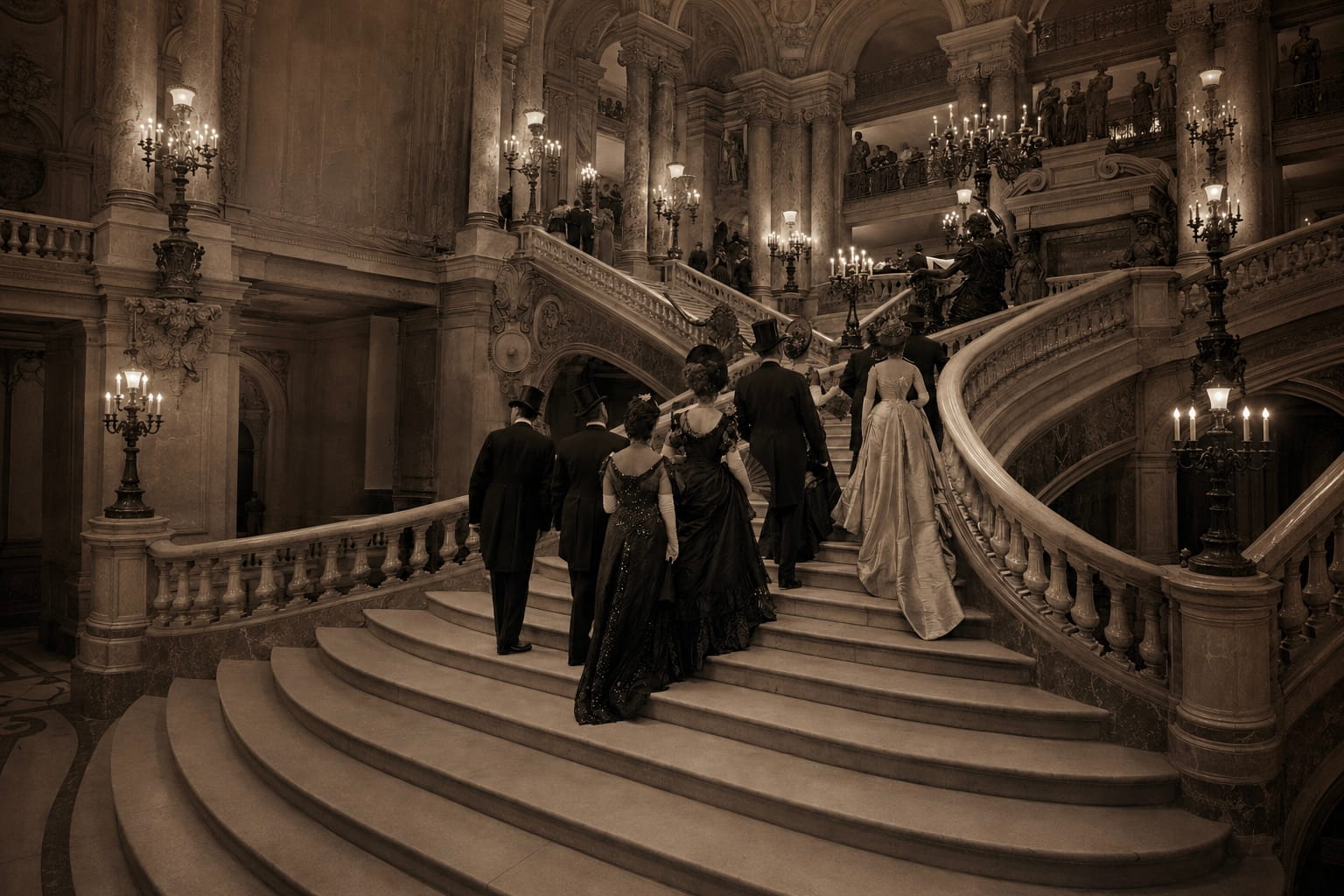
imagined scene of an opera evening in the late 19th century · ai generated
That picture is suggested by the rooms themselves. Their arrangement still makes clear that an evening at the opera was sustained by more than the performance. Being seen and meeting others before the curtain and during the intervals all belonged to the occasion.
Perhaps that is why historic places so often feel alive to me. What survives materially is only part of what I see. For a moment, I also try to imagine the lives that once moved through it.
Red Velvet, Gilding and Chagall
The auditorium changes the atmosphere entirely. After pale marble and long galleries, the palette contracts into red velvet, gold and subdued light. Tiers rise closely above one another, boxes frame the room, and the great crystal chandelier hangs overhead. Garnier chose red velvet partly because its warmth was thought to flatter the complexions of the women in the audience. Even colour participated in the social choreography of the room.
Above this 19th-century interior, Marc Chagall’s vividly coloured ceiling painting has spread across the dome since 1964. Its modern visual language stands in deliberate contrast to the gilded boxes and deep red surrounding it. That meeting of different periods is precisely what makes looking upwards so distinctive.
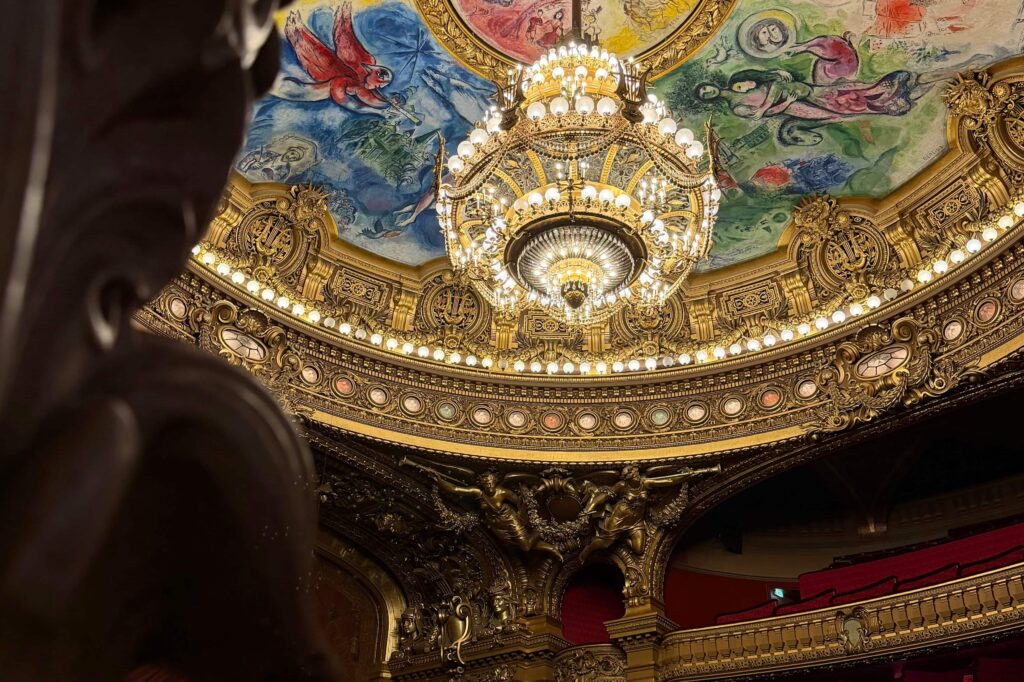
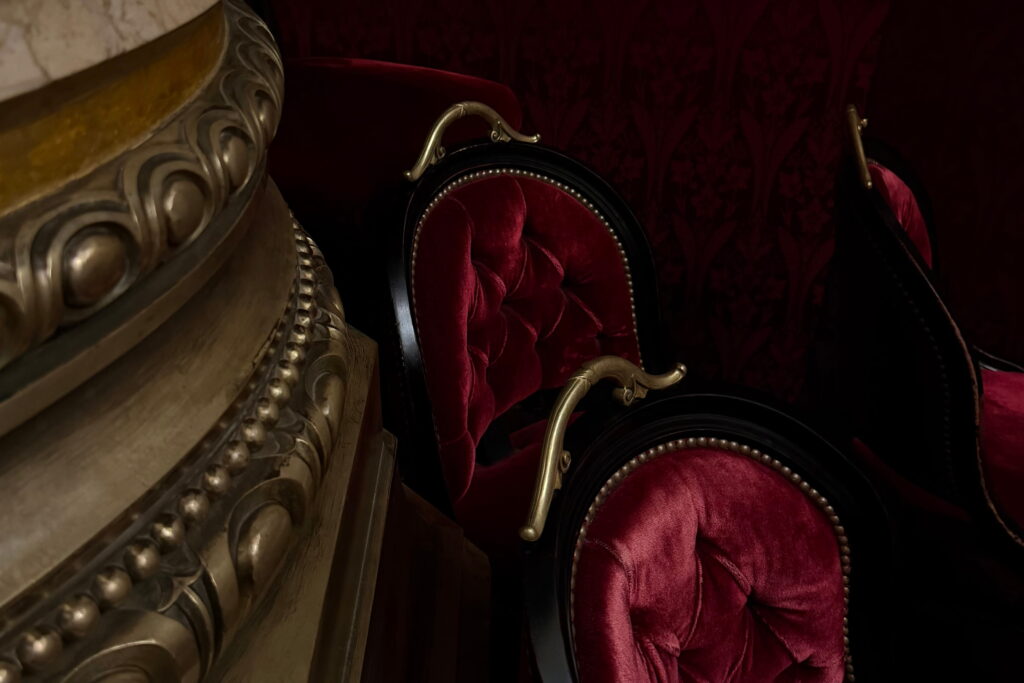
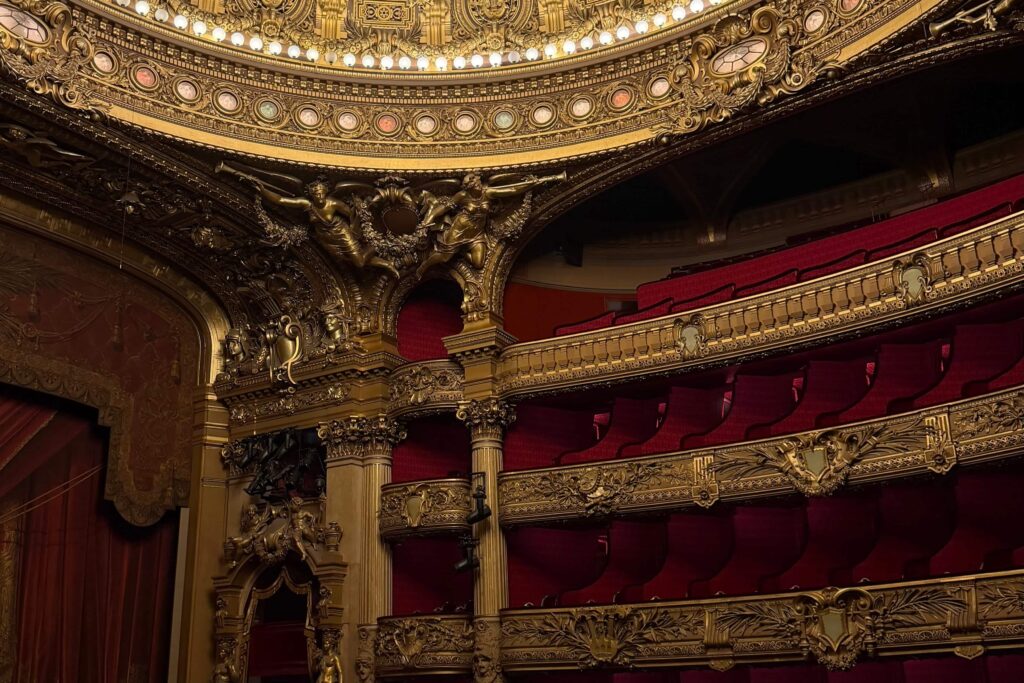
les loges, opéra garnier, paris © elegance & heritage
For all its scale, the auditorium seemed more intimate to me than the great public foyers. Those spaces encourage movement and encounter. Here, everything gathers towards a single point: the stage.
The Order Within the Splendour
In the end, no single room impressed me most. What remained with me was the consistency of the whole. A staircase becomes a place for making an entrance. A foyer becomes a social salon. Even a door handle carries the sign of music. Long before the first note is heard, every part of the building has begun to prepare the visitor for art.
Restraint is not the language of the Palais Garnier. It is colourful, assured and extraordinarily abundant. Yet its splendour never feels random. Architecture, painting, sculpture and craftsmanship are held together by an underlying order.
Perhaps that is where its elegance truly lies. Not in abundance for its own sake, but in the care with which even the smallest element is made to belong to the whole.
Before You Visit the Opéra Garnier
For an unhurried visit to the Opéra Garnier, allow around an hour and a half. Advance online booking is required. A self-guided visit currently costs €15 for adults who are residents or nationals of the European Economic Area and €25 for adults from outside the EEA. As the Palais remains a working opera house, parts of the building, particularly the auditorium, may close at short notice for rehearsals or technical work.
The areas normally accessible to visitors also include the Rotonde des Abonnés beneath the auditorium and the publicly accessible gallery of the Bibliothèque-Musée de l’Opéra.
For an independent visit, admission may also be arranged through GetYourGuide.
Advertisement | Affiliate links: Links marked with an asterisk (*) are affiliate links. If a booking is made through one of these links, I receive a commission. This is at no additional cost to you.
View the ticket for an independent visit to the Opéra Garnier*
The visitor entrance is at the corner of Rue Scribe and Rue Auber. From the booked admission time, there is a thirty-minute window in which to enter. Security checks can delay access, so arriving a few minutes early is advisable. Proof of eligibility is required for the EEA rate and other concessions. As admission prices, opening hours and visiting conditions may change, it is worth checking the latest information from the Paris Opera before your visit.