The Dignity of Discretion

AI generated
A conversation held in confidence should not reappear at somebody else’s table. A private message was not written to be passed around, and learning something about another person does not make it ours to retell.
Discretion begins with recognising this distinction. Knowledge does not carry with it an automatic right to disclosure. Nor is discretion confined to keeping an explicitly entrusted secret. It is revealed in the way we handle other people’s affairs, in the questions we ask, in the things we leave unsaid, and in the care with which we guard the boundaries of our own lives. It requires restraint, judgement, and an understanding that intimacy never grants a licence to expose.
There is a quiet decency in knowing what belongs to us, what has merely been placed in our keeping, and what was never ours to dispose of at all. Some things are best left exactly where they belong, with the person whose life they concern.
Discretion, then, is neither reserve for its own sake nor a habit of unnecessary secrecy. It is a form of respect, both for one’s own life and for the lives of others.
The Art of Silence
Not everything one knows needs to be said. The thought may seem self-evident, yet acting upon it belongs to the more demanding forms of self-restraint. Knowledge carries a temptation of its own. Information that others do not possess may be surprisingly difficult to keep untouched. Conversation, curiosity, or even the small pleasure of being the person who knows more than everyone else can make disclosure feel almost irresistible.
That is precisely where discretion begins to show itself. Not in knowing nothing, but in refusing to make use of everything one knows.

AI generated
Character is rarely tested only by great secrets. More often, the test arrives quietly: a family difficulty mentioned in passing, a worry that surfaced during a private conversation, an observation never intended for another audience, or a circumstance discovered by accident.
The absence of an explicit request for silence does not make every confidence available for circulation. Genuine attentiveness includes the ability to recognise a boundary before another person is forced to name it.
Other People’s Stories Belong to Them
When someone tells us something personal, they place something vulnerable in our hands. It may be a worry, a disappointment, a mistake, a hope, or an uncertainty. No promise of secrecy may have been requested, yet responsibility has already arisen. A confidence is unlike an ordinary gift. A gift changes ownership. What is entrusted to us does not. We may be allowed into a part of another person’s life, but that part remains theirs. Being permitted to know about it gives us no authority to dispose of it or turn it into material for our own conversations.
The discreet person does not treat other lives as a source of stories. A confidence does not lose its private character because it happens to be fascinating, nor is the responsibility removed simply by withholding a name. Context alone may be enough to identify someone. Yet even where identification would be impossible, an indiscretion may still have taken place. The breach is not always the revelation of identity. Sometimes it lies in making another person’s private experience into entertainment for people to whom it never belonged.
Respect also means leaving people in possession of their own story. What they wish to reveal should be revealed by their choice, in their words, and at a time of their choosing.
The Right to an Inner Life
Discretion concerns more than what others entrust to us. It also shapes the way we handle our own lives.
Sincerity does not require complete exposure. Honesty and total disclosure are not the same thing. A person may be truthful while still keeping parts of life beyond the reach of a general audience. Some joys do not become greater through display. Some relationships are not improved by admitting spectators. A plan need not be announced before it has taken form. Certain experiences lose something of their preciousness when they are turned too quickly into photographs, explanations, and words.
Part of life is allowed simply to be lived.
There is a particular peace in possessing memories that require no explanation. An evening for which no photograph exists. A conversation whose words remain between two people. A gift whose deeper meaning belongs to no one else. A happiness that does not require evidence in order to have been real.
Privacy is not secrecy. It is the deliberate choice not to open every room of one’s life to everyone.
The Limits of Curiosity
Discretion can be heard in what a person says, but it can be recognised just as clearly in what they refrain from asking.
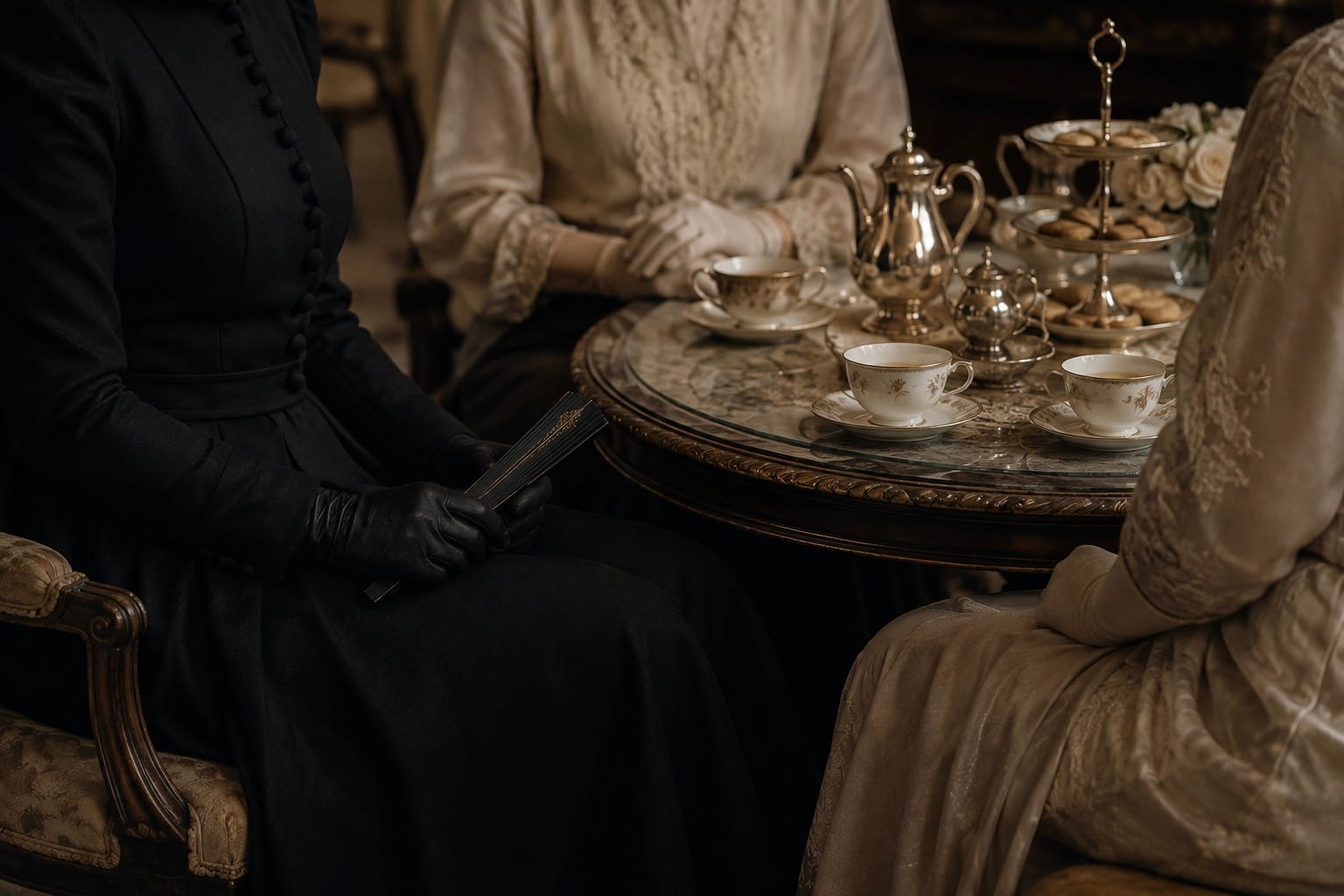
Curiosity does not acquire a right to satisfaction merely because it exists. Some questions appear harmless while reaching into parts of a life that only the person concerned has the right to open. The price of a gift, a marriage that has not happened, a couple without children, a setback at work, distance within a family, or a private worry does not become legitimate conversational territory simply because something about it can be seen from the outside.
AI generated
A tactful person understands that every noticeable change does not call for an explanation. Others are given the opportunity to speak if they wish, and the equal freedom not to speak at all. Sometimes tact has less to do with finding the right words than with leaving a question unasked. Such restraint is not coldness. It comes from the kind of attention that notices hesitation, understands a change of subject, and does not demand that a boundary be explained before agreeing to respect it.
Here, discretion becomes a form of good manners in its deepest sense.
Quiet Reliability
Perhaps the greatest value of discretion is the trust it makes possible. There is an important difference between someone to whom we can say many things and someone to whom we can safely entrust something. Charm does not create that difference. Neither does sociability or ease in company. Its foundation is reliability of character.
With such a person, one knows that a private remark will not later become an anecdote, that a vulnerability will not be used on another occasion as a weapon, and that an intimate thought will be neither mocked nor embellished nor carried into a wider circle. Reliability of this kind cannot be claimed into existence. It has to prove itself. Trust therefore grows slowly, while a single act of indiscretion may be enough to destroy it.
Someone who knows how to guard what has been entrusted to them possesses a kind of elegance that clothes, family background, and social knowledge can never confer. Its source is character itself.
The Duty of Restraint
Discretion also requires the ability to keep a thought unspoken even when we believe it to be true.
Not every observation deserves a comment, and not every mistake made by another person needs to be pointed out. Truth does not automatically become more valuable merely because it has been voiced. Some truths need to be spoken. Others may help someone or prevent harm. But there are also truths whose only effect would be to expose another person, wound them, or display the speaker’s own perceptiveness.
Knowing the difference is a matter of judgement.
Where no one needs protection and no harm has to be prevented, silence may sometimes be the more considerate course.
Such restraint has nothing to do with cowardice or indifference. It asks for an inner order that considers more than whether something is true. It also asks whether we have the right to say it, whether the moment is appropriate, and what purpose the words are meant to serve.
Not everything true should be concealed. But neither must everything true be said.
The Dignity of What Is Kept

AI generated
A dignified life needs places that remain protected.
Friendship needs confidence. A marriage needs a space that does not belong to the gaze of others. Families hold stories that were never meant for everyone. And each person needs thoughts, hopes, and memories that do not have to be explained, judged, or shared.
What is hidden is not always secret. Some things are simply private. Others are delicate, unfinished, or too precious to be placed carelessly in unfamiliar hands. Discretion depends upon understanding the difference.
It appears in silence chosen at the right moment, in restraint without coldness, and in loyalty that does not depend upon being watched. It preserves the dignity of others without turning its own restraint into a performance, and it protects what is personal without withdrawing from the world.
Such a quality may easily go unnoticed. That, in part, is its nature. It does not ask to be admired for keeping silent, nor does it expect gratitude for having kept something safe.
Elegance is revealed not only in the manner in which a person enters a room. It is revealed, too, in what leaves that room with them.