Tawakkul: The Quiet Art of Trust
AI generated
Once a person has done all they can, a certain stillness begins to settle. It can be felt in hospital waiting rooms, in the pause after an application has been sent, or in the silence that follows a difficult conversation. The work is finished. The outcome is not yet known. In that narrow space between effort and result, something is asked of us that no amount of planning can supply.
The Islamic tradition has a name for what belongs in that space. It is called tawakkul, which means trust in Allah. It is also a word that suffers terribly in translation. Rendered simply as “trust” or “reliance”, it sounds passive, almost resigned, as though it were an invitation to sit back and let life happen. It is nothing of the sort. Tawakkul is perhaps the most active form of surrender there is.
Tie Your Camel First
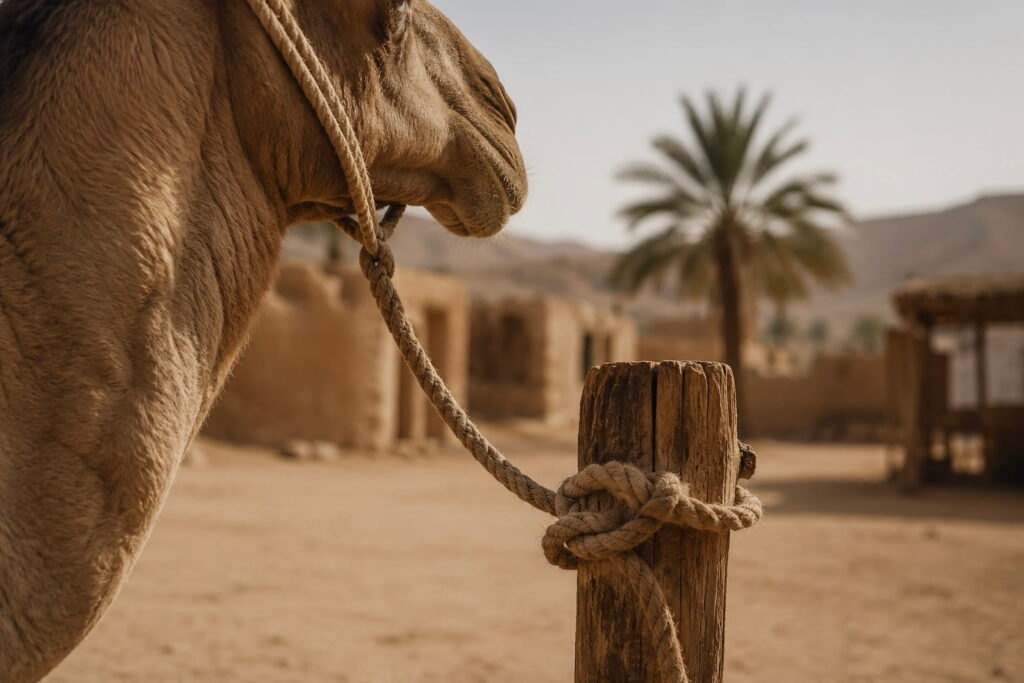
The story most often told about tawakkul is a short one. A man came to the Prophet Muhammad ﷺ and asked whether he should tie his camel and rely upon Allah, or leave it loose and rely upon Allah. The reply has travelled through fourteen centuries without losing any of its clarity:
“Tie it and rely upon Allah.” (Jamiʿ at-Tirmidhī 2517)
Everything one needs to know about tawakkul is contained in that sentence, and in its order. The tying comes first. Trust is not a substitute for effort; it is what effort rests upon. The person who leaves the camel untied and calls it faith has not understood faith. The person who ties the camel and then lies awake all night watching it has not understood trust. Tawakkul lives precisely between the two: do what is yours to do, thoroughly and without shortcuts, and then release what was never yours to control.
AI generated
This is, if we are honest, the opposite of how most of us operate. We tend to do it the other way round: we neglect the preparation and then agonise over the outcome. We revise too little and panic before the examination. We avoid the difficult telephone call and then worry for weeks about what might happen. Tawakkul reverses the arrangement entirely: full seriousness in the doing and full serenity in the waiting.
What Trust Is Not
It is worth being precise about what tawakkul does not mean, because the misunderstandings are common and they do real damage.
• It is not fatalism. The Qur’an does not ask believers to be indifferent to outcomes. The Prophet ﷺ did not confuse trust with passivity. He strategised, consulted, prepared provisions and wore armour into battle. Trust in Allah never made him careless.
• It is not the absence of feeling. To trust does not mean that one stops hoping, grieving or wanting things to go a certain way. The Prophet ﷺ wept at the death of his son Ibrahim and said, “The eyes are shedding tears and the heart is grieved, and we will not say except what pleases our Lord” (Sahih al-Bukhari 1303). Tawakkul does not anaesthetise the heart. It gives the heart somewhere to stand.
• Nor is it a bargaining position. Trust offered on the condition that things turn out as we wish is not trust at all; it is a transaction wearing better clothes. Real tawakkul includes the possibility, and eventually the certainty, that some things will not go our way and that this, too, is held within a wisdom greater than our own.
When Life Does Not Go to Plan
The verse that has carried many people through their hardest seasons is a brief one, from Surah At-Talaq:
“And whoever puts their trust in Allah, then He alone is sufficient for them.”
(paraphrased from Qur’an 65:3)
Sufficient does not mean that everything will be repaired by Friday. It does not promise that the diagnosis will be reversed, that the desired position will be offered or that a closed door will open again.
Allah’s sufficiency means that, whatever comes, we will not face it alone or without His help. It is a quieter promise than the one we would write for ourselves, and a far more durable one.
There is a second verse that belongs beside it, from Surah Al-Baqarah:
“Perhaps you dislike something which is good for you and like something which is bad for you. Allah knows and you do not know.”
(paraphrased from Qur’an 2:216)
Perhaps this is precisely what moves me so deeply about tawakkul: it does not require us to understand every outcome, but teaches us to keep moving forward even when the wisdom behind it remains hidden from us.
Most of us can point to at least one closed door in our past that we now recognise as a mercy: the position we did not get, the plan that collapsed, or the path that ended abruptly and led us somewhere better. At the time, it felt only like loss. The difficulty is that this recognition almost always arrives late. Tawakkul is, in a sense, the decision to extend that hindsight forward: to treat the present disappointment with the same generosity we may one day grant it in retrospect.
The Practice of Trust
Because tawakkul is learnt rather than possessed, it helps to know what the learning actually looks like. It is rarely dramatic. Mostly, it looks like this:
It looks like making duʿā and then genuinely stopping: not rehearsing the request another forty times throughout the day, but leaving it where it was placed, as one posts a letter and does not remain standing beside the postbox.
AI generated
It looks like preparing well and refusing to confuse preparation with control. One can choose the school, the treatment, the route and the words, but one cannot choose the result. Knowing where the boundary runs is half the discipline.
It looks like the morning and evening adhkar, recited not as ornament but as an anchor: small, repeated declarations that the day ahead, whatever it holds, has already been provided for.
It also looks like patience with oneself. Anyone who claims to have mastered trust has probably not been tested recently. The believer’s trust wavers, returns, deepens and wavers again. The Qur’an describes the prophets themselves calling upon their Lord in hope and fear. Wavering is not the failure of tawakkul but the very ground on which it is built. One does not learn to trust in calm weather.
A Quieter Way to Live
There is an elegance to tawakkul that has little to do with aesthetics and everything to do with proportion. The person shaped by trust carries only what is theirs to carry. They plan without clenching. They hope without demanding. They remain standing when bad news comes, because their footing never depended upon the outcome in the first place.
This is not a temperament that some people are born with and others must envy. It is an unhurried, frequently imperfect practice, renewed each morning. Like most practices worth keeping, it is learnt slowly, mostly in the seasons we would not have chosen.
Hasbunallahu wa niʿmal wakeel means, “Allah is sufficient for us, and He is the best One in whom to place our trust.” Ibrahim (Abraham), peace be upon him, spoke these words when he was cast into the fire. Allah commanded the fire to be cool and safe for him (Qur’an 21:69). The believers described in Surah Aal ʿImran also spoke them when they were told that an army had gathered against them. The warning did not intimidate them; it increased them in faith. They returned unharmed, favoured by Allah (Qur’an 3:173–174).
More than fourteen centuries later, they remain among the most comforting words ever given to a worried heart.
Further Reading
Advertisement | Amazon affiliate links: Links marked with an asterisk (*) are affiliate links. If a purchase is made through one of these links, I receive a commission. This is at no additional cost to you. As an Amazon Associate I earn from qualifying purchases.
For readers who would like to explore more deeply how the Qur’an speaks to inner change, faith and the way we respond to life’s circumstances, Mohammed Al-Ubaidy’s The Mirror: Change What’s Within and Reality Has No Choice But to Follow offers a contemporary reflection on these themes. Tawakkul reminds us that the outcome remains with Allah; this book turns our attention towards what does lie within our responsibility: the condition of the heart, the choices we make and the work of becoming.
Discover the book here*